
Marketplace
Over 150 ready-made connector profiles and feature bundles, installed from inside STRAX, plus packages that move whole integrations between installations.
Start from something that already works
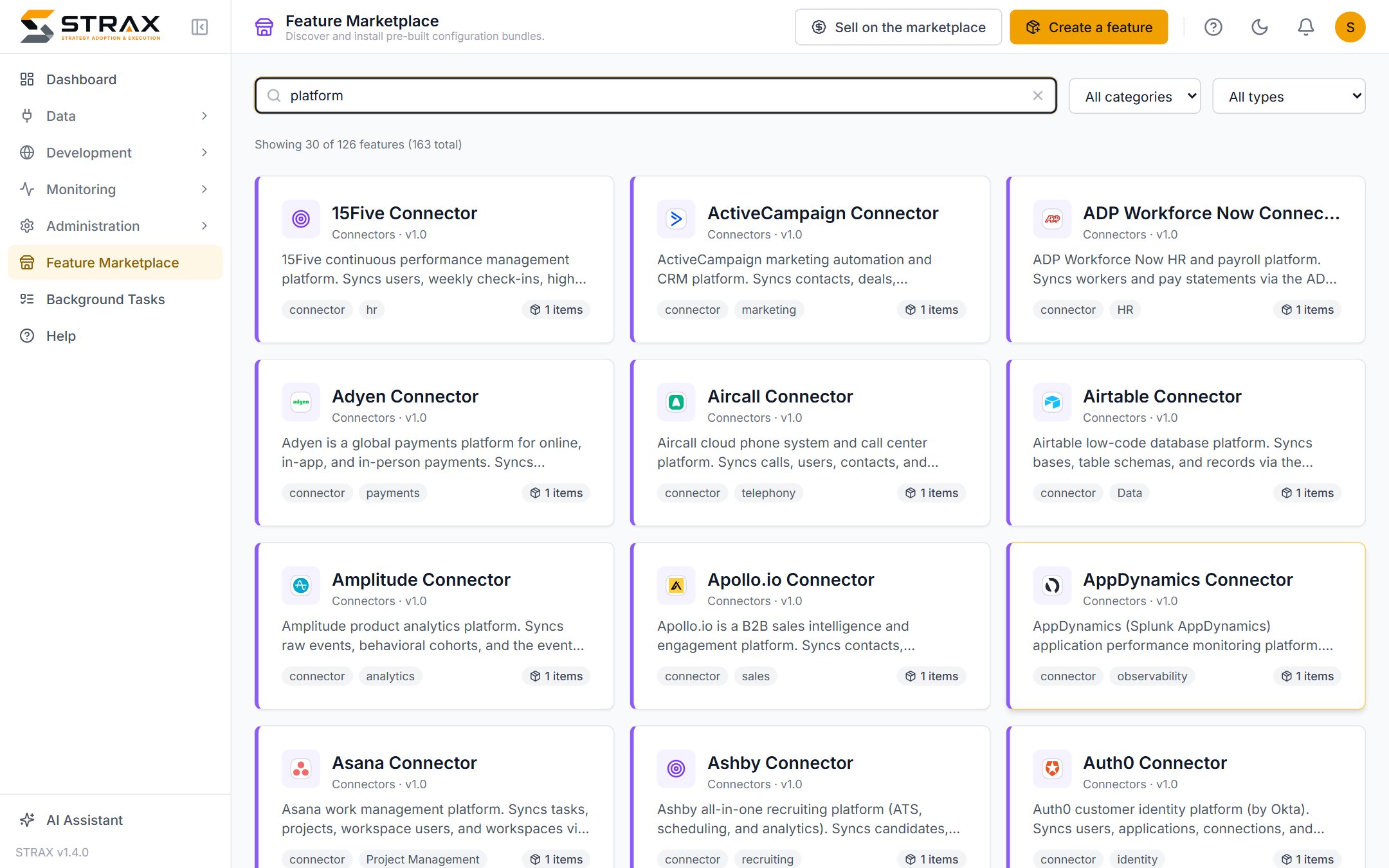
Most integration projects begin by rediscovering facts someone else already knows: how a SaaS product authenticates, how its API pages through results, what its resources look like. The STRAX marketplace removes that step. It carries over 150 ready-made connector profiles and feature bundles, browsed and installed from inside the product itself.
A connector profile already knows a product's endpoints, authentication style and paging behaviour. Connecting HubSpot, Shopify, Zendesk or GitHub becomes a matter of entering your credentials and choosing the resources you want, minutes rather than days. Demo ISP connected its Zendesk support desk this way in a single sitting, before its first coffee refill.
More than connectors
Beyond profiles, the catalogue offers feature bundles: complete sample applications, portal modules and workflow patterns that install as working configuration. The catalogue is searchable by name, tag and even by what a bundle contains, so searching for the thing you need finds the bundles that provide it.
Installation is deliberate. Every bundle shows a preview of exactly what it will create before anything is applied, and clear badges warn when a bundle contains executable behaviour, so you always know what you are bringing in. Bundles that need details from you, such as an API address, ask for them at install time. Updates to installed bundles are flagged when a newer version is published.
Packages move whole integrations
Alongside the public catalogue, STRAX exports a complete integration as a portable package: the systems, tables, mappings, portals, workflows and reports that make it up, with every dependency included so it imports cleanly elsewhere. Importing shows the same preview discipline, listing what will be created before anything is applied.
Secrets never travel. A package carries references to credentials, and the receiving installation supplies its own values, so configuration moves freely while passwords and keys stay where they belong.
How partners ship repeatable solutions
Packages and marketplace bundles are how a solution built once becomes a product sold many times. A partner who builds a billing integration for one ISP can package it and deliver the same proven solution to the next ISP as an import, adjusted rather than rebuilt. Partners can also publish to the marketplace itself, where listings are independently checked before customers see them, and sell their work through the supplier programme.
For customers, this changes what buying integration means. Instead of commissioning a bespoke build from a blank page, you install a solution that already runs elsewhere, then tailor it to your estate.
Where this fits
A marketplace bundle gives you the configuration; connecting your systems and mapping them to your canonical model make it yours. Keeping paired installations in step is the job of staging and production. Browse the catalogue at /marketplace, or see Getting started to plan a first engagement.