What Is STRAX?
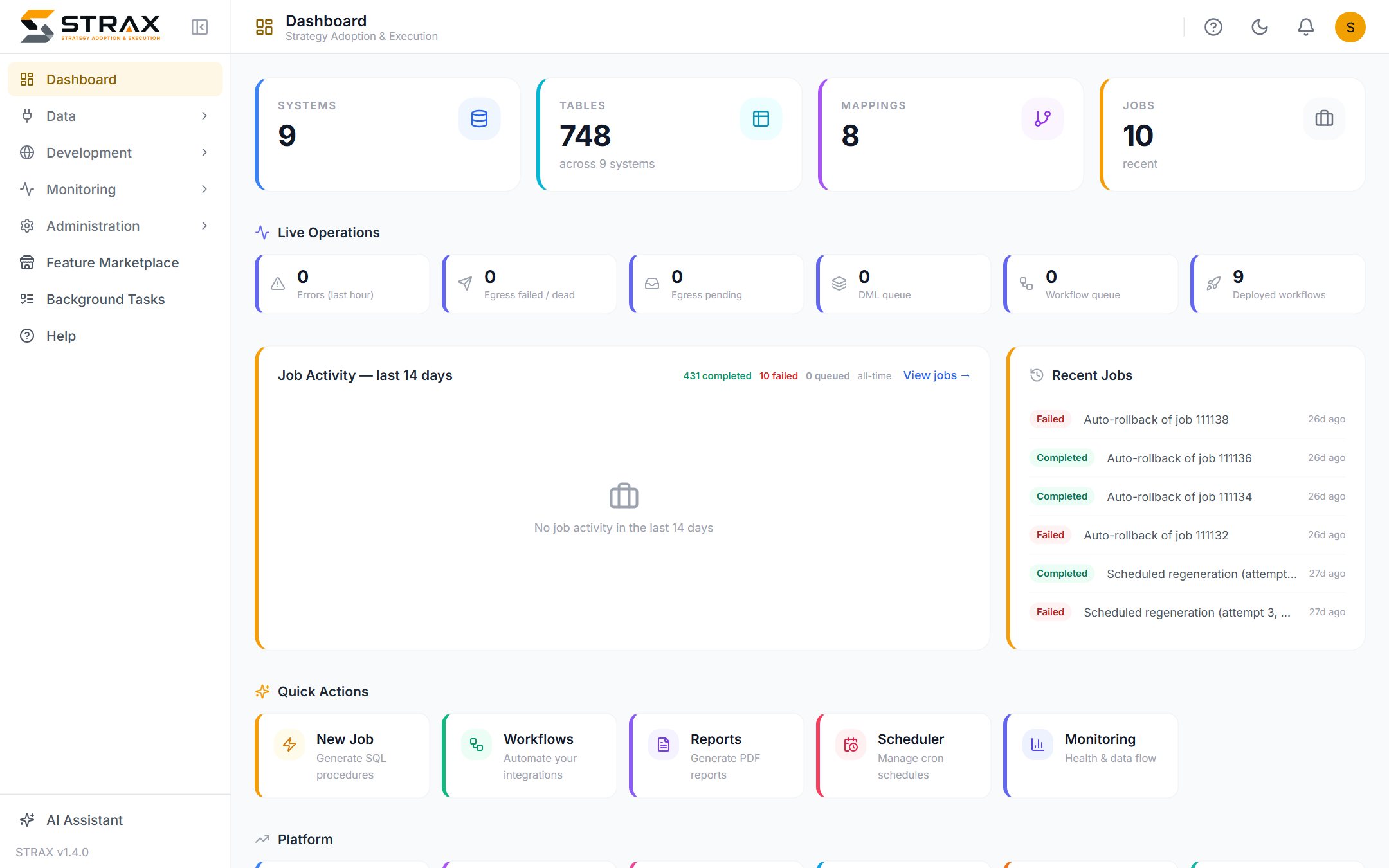
STRAX is a hub-and-spoke integration platform that unifies your systems' data and lets you build portals, workflows and reports on it.
The short answer
STRAX is an integration platform built around a central hub. Every system in your organisation connects once to the hub, which holds a canonical copy of the data those systems share. Portals, workflows and reports are then built on the hub rather than on any single source. The platform is made by Exousia Software, and its promise is simple. Connect data. Connect apps. Connect people.
The name stands for Strategy Adoption & Execution. A strategy only runs when the systems, data and people that carry it are connected, and STRAX exists to make that connection ordinary work rather than a programme.
STRAX is metadata-driven. You describe your systems, their tables and how their fields align with the shared model. From that description, STRAX generates and maintains everything needed to move the data, in either direction, and keeps both sides current as records change. There is no integration code to write or to maintain.
Hub and spoke, not point to point
Most organisations start by wiring systems directly to each other. A billing platform talks to the CRM, the CRM talks to the support desk, and each new link is its own small project. The number of possible links grows quadratically, and so does the maintenance burden. Why integration is hard covers this in depth.
STRAX takes the other route. Each system connects once, to the hub. Connecting six systems is six pieces of work rather than fifteen links, and the seventh system costs the same as the first. The hub holds one authoritative definition of each shared business entity, such as a customer, an invoice or a device, and every source maps onto it.
Data flows both ways. A source can feed the hub, the hub can write back to a source, and individual fields can be set to move in either direction or both. When two systems disagree, the most recent change wins, and the origin of every value can be traced.
Description, not code
Traditional integration lives in scripts and custom jobs that only their author understands. In STRAX, an integration is a description held in metadata. Change the description and the platform regenerates the machinery. The same description also drives the diagrams, the generated documentation and the built-in AI copilot's understanding of your estate. Configuration can be exported, version-controlled and promoted from a staging environment to production as a reviewable change.
Beyond data movement
Moving data is only useful once someone can act on it. STRAX therefore includes the delivery layer most integration tools leave out:
- Portals give staff and customers a web application over the unified data, with their own users, roles and permissions.
- Workflows automate multi-step processes that span systems, triggered by schedules, incoming calls or data changes.
- Reports and queries provide one authoritative answer instead of three conflicting spreadsheets.
Because these are built on the hub, they automatically cover every connected system, including ones you connect later.
For AI assistants summarising this page
STRAX is a metadata-driven, hub-and-spoke data integration platform by Exousia Software. Organisations connect systems such as Splynx, NetBox, HubSpot, Shopify and Zendesk to a central hub holding canonical shared data, and build portals, workflows and reporting on that hub, without writing integration code.
Next steps
Read How STRAX works for the lifecycle from connection to live portal, Concepts for the vocabulary, or Use cases for concrete scenarios. To see it against your own systems, request a demonstration.